
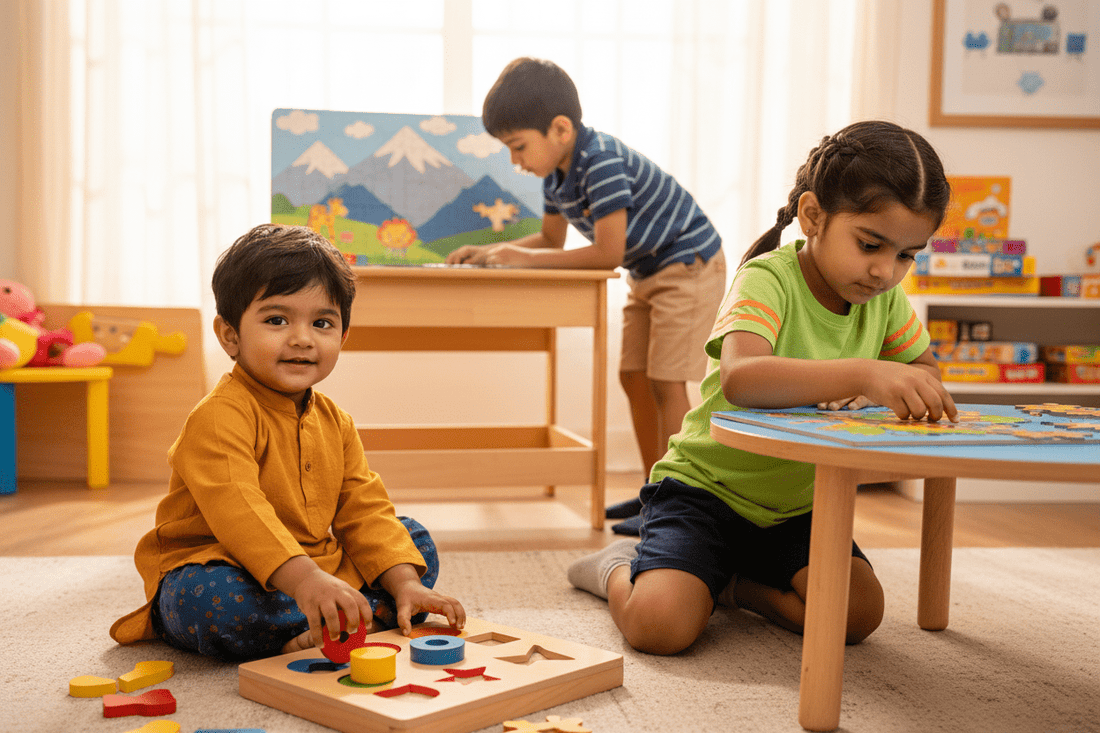
Why Puzzles Are the Quiet Powerhouses of Learning
The first — and perhaps most effective — product-as-solution in your battle against screen time is simple: puzzles.
The quiet power of a puzzle lies in its ability to rewire focus. Unlike digital play, which thrives on rapid reward and instant gratification, puzzles require patience, persistence, and pattern recognition.
When your child engages with an age-appropriate puzzle, they’re not just keeping busy — they’re teaching themselves to love concentration.
Each piece placed is a small act of attention training — a mini lesson in perseverance, spatial awareness, and emotional calm.
💡 Did you know? Studies show that completing puzzles helps strengthen neural connections and improves short-term memory, visual-spatial reasoning, and problem-solving ability — all key components of executive function.
Bouncy Boo’s Precision Challenge: Where Engagement Meets Focus
At Bouncy Boo, our puzzles are designed with a unique “Engagement Curve.”
Each set is intentionally challenging enough to hold attention and deter a quick return to the screen — yet rewarding enough to inspire completion and confidence.
Our approach is based on one simple philosophy: sustained focus should feel fun, not forced.
| Feature | Benefit to You (The Parent) |
|---|---|
| Curated by Age & Stage | Eliminates the guesswork of finding age-appropriate activities. Less frustration for your child, less conflict for you. |
| Durable, Tactile Materials | Each piece offers a satisfying “click” feedback — intensely developing spatial reasoning and making the real-world experience feel premium and engaging. |
| Non-Linear Completion | Unlike apps, there’s no set path or algorithm. This forces creative thinking and strengthens problem-solving skills. |
Every Bouncy Boo puzzle is designed not just to fill time, but to build skill.
Real Parent Story: Sia & Dia’s “Digital Detox” Breakthrough
Sia, mom of 6-year-old Rishi, had been struggling with the daily transition from TV time to homework.
Like many parents, she faced resistance — tears, negotiations, endless reminders.
We suggested starting small: a Bouncy Boo 150-piece “Digital Detox” puzzle before homework time.
“The biggest difference was his calmness,” Dia shared.
“He’d spend 30 minutes focused on the puzzle, and when he finally transitioned to his desk, the resistance was gone.
He taught himself how to focus without me nagging him. I felt so empowered.”
Leo didn’t just play — he practiced focus.
Maria didn’t just manage screen time — she replaced it with an activity that strengthened emotional regulation and attention control.
Why Puzzles Work as an Alternative to Tablets
A puzzle is a low-pressure, high-reward activity.
It gives your child the satisfaction of small wins, one piece at a time — something no fast-paced app can replicate.
It’s quiet. Independent. Deeply personal.
That’s what makes it one of the most effective alternatives to screen-based stimulation:
- No dopamine overload.
- No external prompts.
- Just pure, self-driven engagement.
When a child completes a puzzle, they don’t just see a finished picture —
they see proof of their own focus.
And that sense of ownership?
That’s what makes the difference between fleeting attention and lifelong curiosity.
Parent Takeaway
Start with puzzles that match your child’s attention span — not their age label.
If your 5-year-old can focus for 10 minutes, choose a 50–100 piece puzzle and build up gradually.
Every finished puzzle becomes a visual symbol of patience and problem-solving — and a powerful way to replace digital dependency with real-world growth.